Which Fuel Solution is Better for Operational Efficiency?
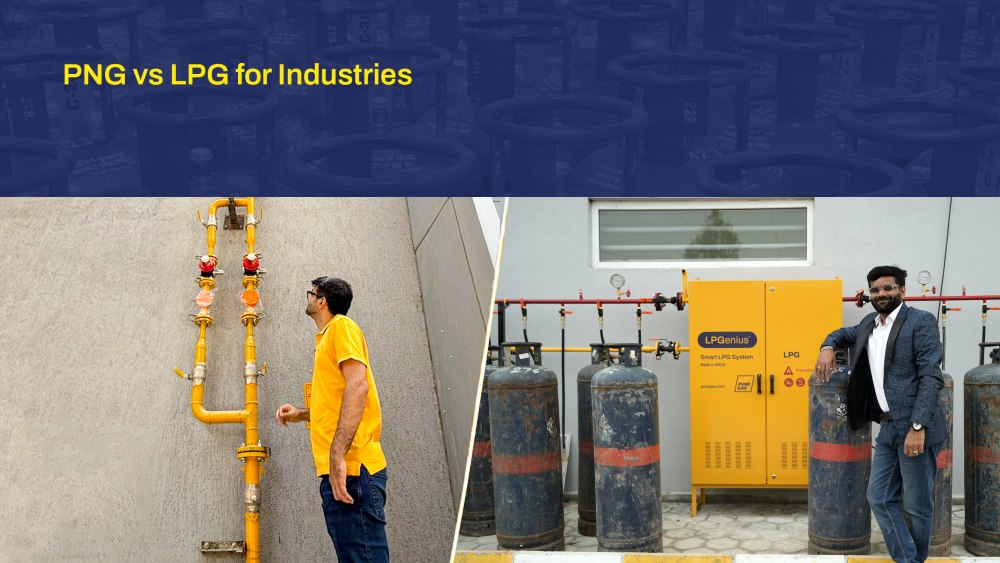
For industries where uninterrupted fuel supply is critical, choosing the right energy source directly impacts productivity, operational efficiency, scalability, and safety. Two of the most commonly used industrial fuel solutions are PNG (Piped Natural Gas) and LPG (Liquefied Petroleum Gas).
While both fuels serve industrial applications effectively, the ideal choice depends on infrastructure availability, operational flexibility, pressure requirements, and continuity of supply.
Understanding PNG & LPG
PNG is supplied directly through a pipeline network, offering continuous fuel supply where infrastructure is available. It is commonly preferred in locations with established gas pipeline connectivity.
LPG (Liquefied Petroleum Gas)
LPG is stored in cylinders or bulk systems and supplied through centralized gas infrastructure. It offers operational flexibility and reliable fuel access across multiple industries, including locations where PNG connectivity may not be available.
Common Challenges with PNG
Although PNG offers continuous pipeline supply, industries may face challenges such as:
- Limited pipeline availability in certain industrial zones
- Dependency on external pipeline infrastructure
- Pressure fluctuations during peak demand
- Supply interruptions during maintenance or network issues
- Expansion limitations for growing operations
Common Challenges with LPG
Traditional LPG systems can also face operational issues if not designed properly, including:
- Cylinder freezing during high consumption
- Pressure inconsistency during peak operations
- Improper gas distribution
- Operational interruptions due to unbalanced load handling
For example, standard 19 kg LPG Cylinders operate on a VOT (Vapour Off Take) mechanism, where LPG converts into vapour inside the cylinder itself. During high consumption, rapid vaporization causes the cylinder temperature to drop, often resulting in frost formation or cylinder freezing.
In comparison, 47.5 kg Cylinders operate on a LOT (Liquid Off Take) mechanism, enabling more efficient gas withdrawal during high demand applications.
How Pune Gas Solves These Challenges
At Pune Gas, we help industries overcome fuel supply challenges through reliable and scalable LPG solutions designed for continuous operations.
Our systems focus on:
- Maintaining stable gas supply during peak consumption
- Reducing pressure fluctuations and operational downtime
- Providing flexible LPG solutions beyond PNG network limitations
- Supporting scalable infrastructure for growing industries
- Enhancing operational safety and fuel efficiency
By implementing advanced LPG systems, industries can achieve uninterrupted performance without depending entirely on external pipeline availability.
Our solutions support a wide range of sectors including manufacturing, hospitality, healthcare, food processing, educational institutions, laboratories, commercial operations, and multiple other LPG dependent industries.
PNG vs LPG — Which is Better?
PNG is suitable when:
- Pipeline infrastructure is already available
- Fuel demand remains stable and predictable
- Continuous network supply is reliable
LPG is suitable when:
- Operational flexibility is required
- Industries are located beyond PNG connectivity
- High demand applications require scalable systems
- Reliable backup fuel solutions are essential
- Businesses cannot afford operational downtime
The Right Solution Depends on Operational Needs
There is no one size fits all approach when choosing between PNG and LPG. The right fuel solution depends on operational requirements, infrastructure availability, scalability, and business continuity needs.
At Pune Gas, we help industries implement LPG systems designed for reliability, efficiency, safety, and uninterrupted performance.
Because industries need fuel solutions that keep operations running seamlessly every day.