Understanding the Problem & How Pune Gas Solves It
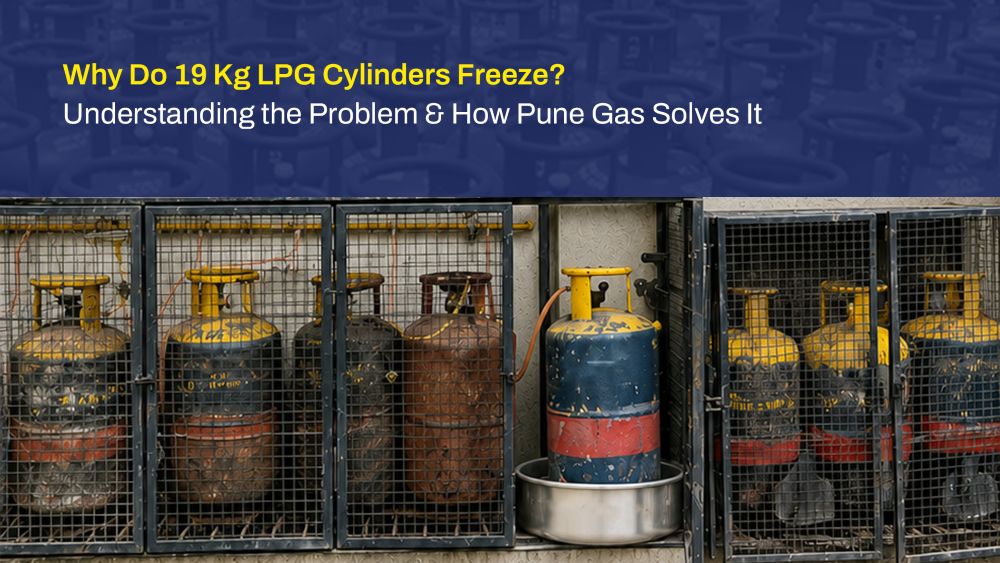
In industries and operations where continuous LPG usage is critical, uninterrupted gas supply plays a major role in maintaining efficiency and smooth functioning. One of the most common issues faced during high LPG consumption is 19 kg LPG Cylinder Freezing.
If you have noticed frost or ice forming around LPG cylinders during operations, it is a clear indication that the gas demand is exceeding the cylinder’s vaporization capacity.
Understanding VOT & LOT Systems
A standard 19 kg LPG Cylinder operates on a VOT (Vapour Off Take) mechanism. This means the LPG inside the cylinder converts from liquid form into vapour within the cylinder itself before being supplied to the application.
During high gas consumption, rapid vapour generation causes the cylinder temperature to drop significantly. As the temperature decreases, moisture present in the surrounding air condenses and forms frost or ice on the cylinder surface.
Standard 19 kg VOT Cylinders generally have a vaporization limitation of approximately 0.5 kg/hr under continuous usage conditions. However, in many commercial and industrial applications, even a single oven can consume nearly 1 to 1.5 kg/hr of LPG, while multiple burners operating simultaneously can push gas demand significantly higher. This mismatch between demand and vaporization capacity is one of the primary reasons behind pressure drops, inconsistent flame performance, and cylinder freezing during peak operations.
On the other hand, 47.5 kg LPG Cylinders operate on a LOT (Liquid Off Take) mechanism, where LPG is withdrawn in liquid form and then converted externally through specialized Dry Type Vaporizer Systems.
Unlike VOT cylinders, 47.5 kg LOT Systems can support withdrawal capacities of up to 5 kg/hr or more depending on operational requirements, making them far more efficient for continuous and high demand LPG applications.
LOT systems are specifically designed to handle higher LPG demand efficiently while minimizing freezing related issues during continuous operations.
Why Do 19 Kg LPG Cylinders Freeze?
Cylinder freezing commonly occurs due to:
- High gas withdrawal from a single VOT cylinder
- Continuous LPG consumption during peak operations
- Multiple equipment lines connected simultaneously
- Improper gas distribution systems
- Lack of load balancing between cylinders
This issue is frequently observed across industries with continuous or high LPG demand, including commercial kitchens, hospitality, healthcare, manufacturing, food processing, educational institutions, laboratories, community kitchens, and multiple other LPG dependent sectors.
Problems Caused Due to Cylinder Freezing
Freezing can directly impact operational performance by causing:
- Low flame or pressure inconsistency
- Interrupted gas flow
- Reduced equipment efficiency
- Operational downtime
- Productivity loss during peak demand hours
Even when LPG is available inside the cylinder, insufficient vapour generation can restrict effective gas supply.
How Pune Gas Solves This Problem
At Pune Gas, we provide advanced LPG systems & solutions designed to ensure seamless and uninterrupted LPG supply across industries.
LPG LOT System
Our LPG LOT System utilizes 47.5 kg LOT Cylinders for efficient liquid LPG withdrawal, helping businesses overcome the limitations of traditional VOT cylinders during high demand operations.
The system ensures balanced gas flow, stable pressure, and consistent operational performance even during continuous usage.
Centralized LPG Manifold Systems
Our manifold systems help distribute load efficiently across multiple cylinders, reducing stress on individual cylinders and improving overall system reliability.
Vaporizer Based Solutions
For high consumption applications, Dry Type Vaporizers support continuous LPG vaporization without pressure drops or freezing interruptions.
The Result?
With Pune Gas solutions, businesses benefit from:
✔ Consistent Gas Performance
✔ Improved Operational Efficiency
✔ Reduced Downtime
✔ Enhanced Safety
✔ Reliable LPG Supply During Peak Operations
Because operations powered by LPG require systems built for reliability, efficiency, and uninterrupted performance.